Monday, May 2, 2011

Casablanca and Rabat: Rainbows and the Roma Knife

This past weekend, I headed to Rabat and Casablanca. First, we took the train from Meknes to Rabat. We arrived in Rabat in the evening and headed to the shore. It was beautiful! Mustafa,  a high school student from Azrou, came with us. It was a trip of firsts for him!


When we came back from dinner on Friday night, we were locked out of our hotel. We soon realized, after hearing shouting from inside, that someone else was locked in. The man inside was hilarious and stuck his head out of the window to shout down to us, "I just want a sandwich man!" We tried to pry the door open with a Swiss Army-like knife that I bought in Rome. However, the owner came back in the middle of our unlocking efforts. 


The next day, we visited the Hassan II Tower, which includes a mosque and minaret which were originally intended to be the largest in the world. However,  in 1199, the Sultan Yacoub al-Mansour died during construction and the monuments remain incomplete. The courtyard is full of partial columns.


We visited the Mausoleum of Mohammed V, which is opposite the Hassan Tower and contains the tombs of King Hassan  II, who died in 1999 and his son,  Prince Abdallah. A Quran reader sits in the back right corner of the room (from this view).


We visited the old medina in Rabat and then went kayaking. The water was nice and it was a lot of fun! We only paid 30 dirhams an hour per person. However, the water was choppy and I felt a little seasick by the time we came back to shore. Ty and Rebecca managed to flip their boats on their way back. 


It rained constantly for most of the trip and the wind was bad news for Rebecca's umbrella...


After that, we had lunch with the roommate of one of the other exchange students. We visited ruins, where we saw a rainbow!


After lunch, we caught a train to Casablanca. When we arrived, we wandered around for a while. We found the Hassan II Mosque and snapped a few photos. This is one of a few that we managed to get without the company of drunken passerby. They were a little annoying, but generally friendly, constantly exclaiming, "Welcome to Morocco!"


We had trouble finding a hotel in Casa. At one point, we stopped to talk to locals and ask for directions. While Rebecca and I waited, a man kicked a cockroach in our direction. Our disgusted faces apparently got to him, and he quickly (and repeatedly) apologized. After that, a few of his friends guided us through the sketchier parts of town in search of a place to stay. Honestly, I am glad they were with us. One of the guys, who seemed like he was about 6'5"and wore the ever-present Adidas track suit, was pretty intimidating. As we walked, we passed a gym with his picture on the wall. Basically, I don't think people mess with this dude. Finally, we found a hotel and headed to find dinner. We grabbed chicken sandwiches at a nearby restaurant. There, we met yet another character. A man wandered in and began to chat with us. I am convinced the majority of his vocabulary can be found in the dialogue of "Scarface." He told Joel, "Watch yourself," and voiced his hatred for various ethnic groups. At that point, I was exhausted and unable to offer much of a reaction. 

On Sunday, we visited the Grand Mosque again, the fifth largest in the world. It also has the world's largest minaret. The construction on the Atlantic was inspired by a passage from the Quran which states, "The throne of Allah was built on water." In the daylight, we could see the incredible detail on the outside of the building. The mosque has many modern features, including heated floors, electric doors and a sliding roof. It is one of only a few that allow non-Muslims to visit in Morocco. 


I love how this picture came out! :) These doors looked out over the ocean.


The mosaics inside of the mosque were incredible!


While I really enjoyed the mosque, I expected a little more from Casablanca. I think it might've been different had we traveled with someone from the town, who knew their way around. However, it was a great weekend overall!


Fez and Volubilis: Rain and Ruins

Last weekend, I visited Fez and Volubilis, an archaeological site of Roman ruins near Meknes. We took a grand taxi to Fez in the morning. Unfortunately, we had to wait for about an hour and a half (in the rain) before one came. When we got to Fez, we met up with friends of Kim, one of the other exchange students. We spent most of our time in Fez in the Old Medina, shopping for souvenirs for family and friends.

I have acquired quite a scarf collection since arriving in Morocco...


We also found turtles!


And of course, shoes! I still want to get a pair before I leave, but can't decide which kind I like best!


At one point, an important looking man walked by with quite an entourage. A shop owner told me his name, but all I can remember is that he is a Berber leader. 


There is never a shortage of cats in Morocco...


We ate camel sandwiches for lunch. They are one of my favorite foods that I've had in Morocco. And only 20 dirhams! :) 


The next morning, we introduced Kim's friends to mesemen (sp?) and honey at our favorite cafe, right inside the gate to the Old Medina. They loved it! :)


We took the train to Meknes, then a taxi to Volubilis. Our driver was awesome! He bought us candy and practiced his English with us. Also, his musical selection was impressive and included Hotel California and a few Tracy Chapman songs. We wandered around Volubilis for about an hour and a half. The city was built on a Carthagian settlement in the 3rd Century BC. The area was very fertile and provided numerous exports (including olives) to Rome. Also, there was a fairly large Berber population in the city. When the French settled in Volubilis, they removed all of the remnants of Berber occupation. During the 18th Century, the town was partially destroyed when building materials were taken for the Moulay Ismail palace in Meknes.


According to a friend, the arches were built to celebrate the arrival of the Roman king, who never ended up visiting the town. One of my friends who visited with his class pointed out that there is a clear distinction between the Roman city, which is a clearly delineated grid, as opposed to the more ancient city, which is constructed in a more haphazard fashion.


A woman and her daughter asked us to take pictures with them as we headed out. 


Garrett picked a bouquet of flowers for Rebecca! :) 


On the way back to Meknes, our taxi driver brought us to Moulay Idriss, a town named for the grandson of the Prophet Muhammad. Moulay Idriss came to Morocco in the 8th Century AD from Mecca, where he was persecuted by the caliph. He is considered Morocco's holiest saint and settled in Volubilis to covert locals to Islam. We visited the shrine, but non-Muslims could only view it from behind a bar across the entrance.


Thursday, April 21, 2011

A few things I miss...

So, I do love Morocco, but there are a few things I've come to miss. When Rebecca and I were riding the train back from Asilah, we had a pretty lengthy discussion about the things we miss most from home. It was about 105 degrees, so we decided to torture ourselves by talking about all the things we can't have.

1. SPICE. I was under the impression that Moroccan food would be spicy. I was mistaken. To remedy this situation, I have accumulated a stockpile of hot sauce.


2. Large coffee cups. The first time I ordered coffee at AUI, I couldn't believe the size of the coffee cups.  They are (at most) about half the size of a normal mug. Also, I miss strong coffee.


3. Toilet paper. All of the exchange students learned the hard way that toilet paper is sparse in this country. Most of us carry our own roll, just in case.


4. Mixed gender dorms. Most of the exchange students have decided that we may have chosen the campus least conducive to any form of romance.


5. Salad. The Moroccan version of a salad does usually contain some kind of vegetable, but I have yet to see large quantities of lettuce. Those found at AUI sometimes have noodles and sardines. Not a fan. 


6. Being able to use my electronics without causing an explosion. When I plugged my hair dryer in on my first day in Morocco, it started smoking. Then a few weeks ago, my hair straightener (which I got from the OIP office here) caught on fire. Also, there are often sparks when I plug in my computer charger.


7. JACK. I've seen him a couple of times via Skype, but it just isn't the same. I miss my puppy!


8. My Dad's cooking (and general dinner time entertainment). This should probably be at the top, but I just remembered it. Especially his salmon.  


Other common yearnings among the exchange group included Mexican food, peanut butter and cafeteria food with flavor! 

Al Akhawayn Mosque Visit

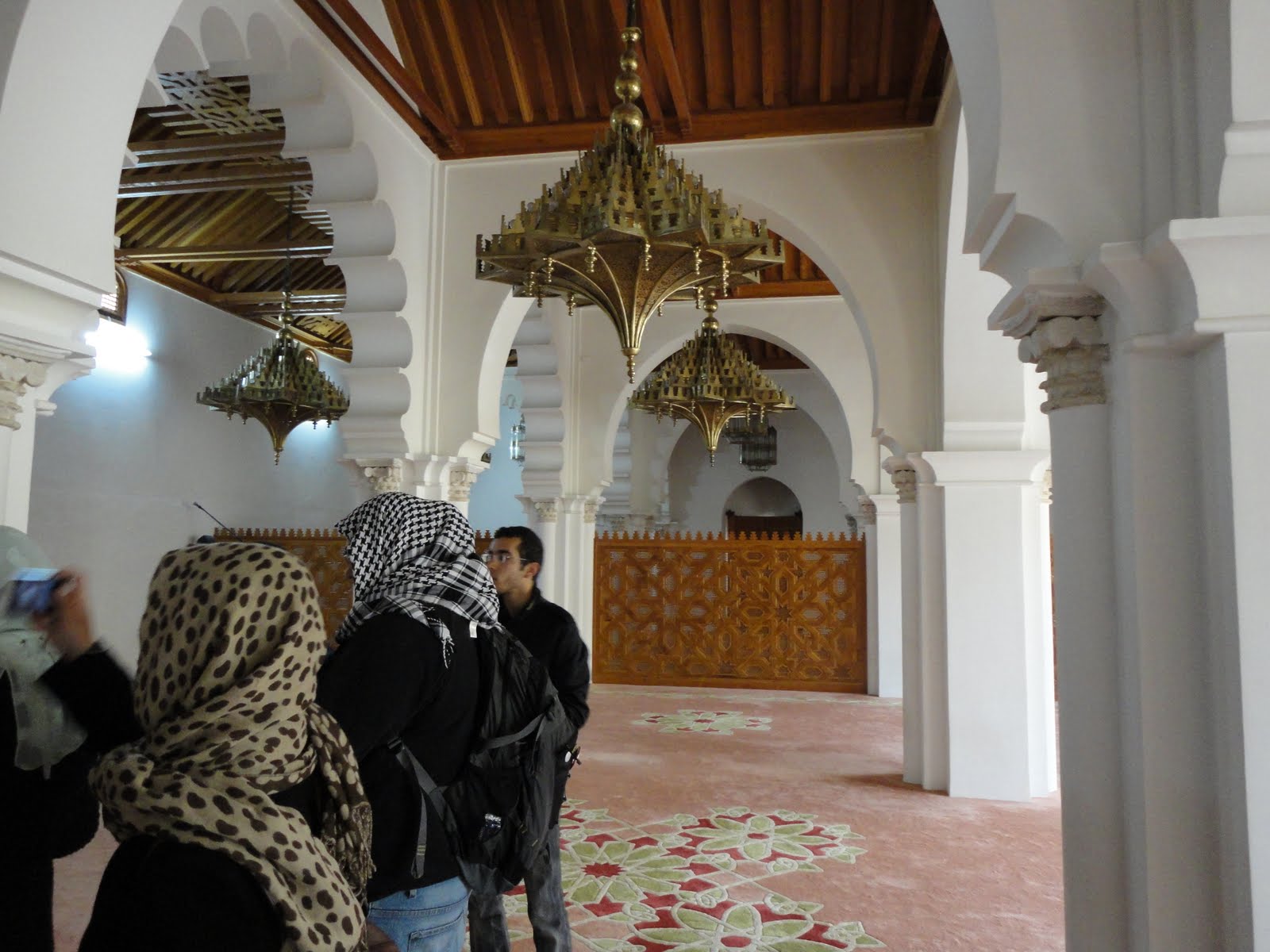
Today, my Islamic Art and Architecture class visited the Al Akhawayn Mosque. Throughout the semester, we have studied the different components of mosque architecture. As we entered, the girls covered their hair with scarves and everyone removed their shoes. Dr. Ennaheid explained that unlike most, the Akhawayn Mosque has glass on its doors and windows, which protects the inside from the lovely weather of Ifrane.


Near the entrance, there is a large poster of the Kaaba in Mecca.


My professor explained that the mosque is Medinan in style. He pulled out the minbar, a large wooden chair-like structure with stairs from which the imam (prayer leader) delivers the sermon, or khutba. The minbar is stored in a small open room to the right of the mihrab, a niche which denotes the qibla. The qibla faces the Kaaba, the direction in which Muslims are supposed to pray.


According to Dr. Ennaheid, the minbar is usually used during Friday services. It allows for the amplification of the imam's voice. He also mentioned the anaza, a respondent who stands near the back of the mosque and repeats the sermon if the congregation is particularly large.


He pointed out the more elaborate decoration on the "T-shape" of the mosque, characteristic of the Medinan style. In the Al Akhawayn Mosque, this shape is formed with nine isles and an axial nave, which intersects the isles in a perpendicular fashion. 


We were standing in the part of the mosque generally reserved for men during prayer. The women's side was separated with mashrabiya, a kind of lattice woodwork which offers a barrier or partition. 


The ceiling in front of the mihrab acts as a dome, which amplifies the voice of the imam. The decoration is completed entirely in plaster, so the artisans had to work quickly to complete it.


He showed us a dry-erase board stored in the corner in an area used as a kuttab, or space for teaching Muslim children the basics of the Islamic faith. After most of the other Moroccan students left, Dr. Ennaheid led us to the bookshelf with different translations of the Quran, including one in English. He noted that there were incidents in Morocco of misprintings of the Quran, which led the government to outlaw the printing of the Quran in Morocco. He  pointed out the Magrebi style of Arabic script in some of the books, as opposed to those printed in Saudi Arabia.